Showing posts with label Advice. Show all posts

Monday, February 25, 2013

Embracing Change


Change is a funny thing. While most of us would like to think of ourselves as flexible, adaptable beings, the reality is that the mere thought of change makes the best of us want to run and hide. Most people are creatures of habit and slight changes to our regular routines can turn us into stressed out, crabby people.

I had somewhat of a panic attack a few nights ago. I will be graduating in a few months, and I am beginning to look at job openings... editing my resume... possibly interviewing...
While lying in bed thinking about my next steps in life I was hit with the weight of doubt.

“Am I ready for all of this?”

After some reflection and tears of panic, I came to the following conclusion: I can be.

I reminded myself that I have got through this kind of change before. About four years ago (has it been that long?) I graduated from undergrad, applied, interviewed and landed a great job. I moved to a new state, a new city... adapted and survived.

Though there are some clear differences, my coping skills are the same... so here ya have it… how to: 

Tuesday, January 22, 2013

A Tip: How to tell Military Time

Just a quick tip for today.

Military time: It is used all over the world though not much here in North America. I have heard a lot of people have trouble translating the time when listed in military time – or a 24 clock – in their heads. I learned a trick as a kid, and here I am going to share it with you:

All I do is take away 2 from any number listed in military time (above 12) and drop the first number.

Examples:

1300 becomes 1 because 13-2=11. Drop the first 1 and you are left with a 1.

2100 becomes 9 because 21-2=19. Drop the first number from 19, the 1, and you are left with a 9.

I have tried to explain this to other people and they look at me like I’m crazy. To me, this makes perfect sense and I hope it does for you too. :-)


Tuesday, January 8, 2013

Top 6: Rules of An Apology

Tendering a genuine apology when an apology is due can go a long way to repair a disconnection following a fight.  Saying “I’m sorry” may sound easy (or for those who are stubborn, maybe not) but there’s actually a right way, and a wrong way to do so. Here's how to apologize wisely and well.
The next time you offer an apology--or, you're on the receiving end of an apology that doesn't cut it-- remember this:
1.  A true apology needs to be sincere. An “I’m sorry.” should not be a quick way to get out of a predicament or a fight.
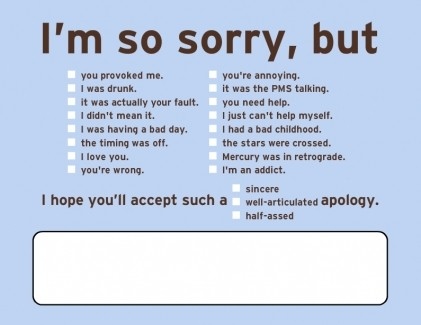
2. A true apology does not include the word “but” (“I’m sorry, but …”).  “But” automatically cancels out an apology, and nearly always introduces a criticism or excuse.
3. A true apology keeps the focus on your actions—and not on the other person’s response. For example, “I’m sorry that you felt hurt by what I said at the party last night” is not an apology. Try instead, “I’m sorry about what I said at the party last night. It was insensitive and uncalled for.” Own your behavior and apologize for it—period.
4. A true apology doesn’t get caught up in who is to blame and who started it. Maybe you’re only 14% to blame and the other person provoked you. It can still help to simply say, “I’m sorry for my part in this.” 
5. A true apology does not demand or request forgiveness. Of course, you hope that the other person will forgive you. But a true apology does not ask the other person to do anything—not even to forgive. Also a serious hurt or betrayal requires repair work over time, and is never healed simply by saying “I’m sorry.”
6. A true apology requires that you do your best to avoid a repeat performance. Obviously, it doesn’t help to apologize with a grand flourish and then continue the very behavior you are apologizing for; Passionate expressions of remorse are empty if you don’t put sincere effort into ensuring that there is no repeat performance.

BONUS- Number 7: When you are really sorry...Flowers, candy... or even a coffee... never hurts.
Postscript: If the other person is an entrenched non-apologizer, don’t get into tug of war about it. Some people cannot or will not apologize. He or she may have another way of re-connecting after a fight, show you he’s in new place and wants to move on.
Accept the olive branch however it’s offered. Focus on becoming a “good apologizer” yourself and model the behavior you want to see in others.
Take the high road. It’s hard. And it’s worth it.


Tuesday, December 4, 2012

Keep Calm & Don't Worry


Buddhist monks and Zen practitioners have a saying on why there is no use in worrying.
The Buddhist proverb on worrying:
“If you have a problem that can be fixed, then there is no use in worrying. If you have a problem that cannot be fixed, then there is no use in worrying.” – Buddhist proverb
People worry about what might — or might not — happen in the future.    Worry is all in our heads — it is anticipation.  Worry goes hand in hand with fear and anxiety… as if the three of them are merrily skipping along in a field of poison poppies; Worry serves absolutely no purpose… in fact, worry will make you physically sick if you worry long enough.
Worry is a cognitive process in the brain, which means it comes from the thinking part — the part that visualizes and thinks; the part that is responsible for our mental processes of perception, remembering, thinking, memory, awareness, judgment, and reasoning.
Lately, I have been worrying about:
1)     Getting this last paper finished
2)    Receiving my new debit card in the mail
3)    Christmas shopping
When I worry, I do three things. First, I calculate its importance. Is it going to happen soon? Do I really need to be thinking about this right now? Next, I ask if I have any control over it. Is worrying going to change the outcome? Finally, if I have decided I have at least some control, I decide what I can actually DO to ease my worry. What action can I take?
Let’s look at my list again, now evaluated:
1)      Getting this last paper finished – This is high priority (Due Friday), and I have control over getting it done.
2)     Receiving my new debit card in the mail – This is important, but I have ZERO control over when it arrives. So why worry?
3)     Christmas shopping – This is important, but I can control how I organize my shopping to be less stressful.  I love making lists.

Worry can be stopped — the mental process can be tinkered with. After going through my steps, I feel better. I feel like I have more control, even if I really don’t.  Remember, it’s a cognitive process so you have control over it!  Worry is really all about the imagery in your mind. Create a more positive image, and focus your thoughts on it.  There is no point in dedicating energy to something that may — or may not — happen.  If it does happen you’ll deal with it when the time comes.  If it doesn’t happen, you’ve just wasted your energy.  Worrying does nothing at all to benefit any situation.  In fact, it just drains you mentally and physically.
As my mother says, “Just Breathe.”

Thursday, June 21, 2012

Advice


I made a shoe purchase yesterday based off this logic.
Related Posts Plugin for WordPress, Blogger...